
Back to Blog
Estimating Tips
7 Costly Construction Estimating Mistakes That Quietly Drain Your Profits
Estimating Partner LLC August 18, 2026 7 min read
Estimating Tips
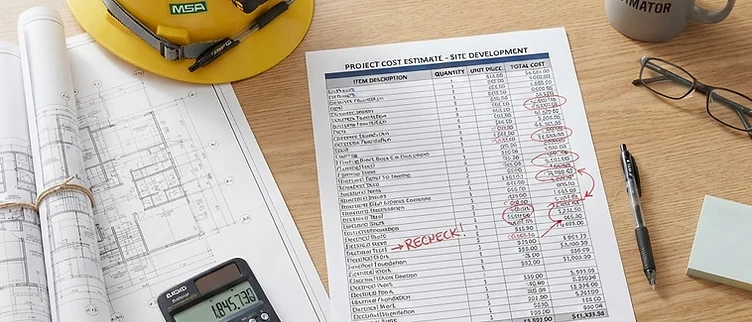
You won the bid. You mobilized. Then halfway through the project, the numbers stopped adding up. Sound familiar?
According to a QuickBooks survey, over 40% of contractors operate on margins below 5%. That means even a small estimating error — a missed line item, an outdated unit price, an underestimated labor hours — can turn a profitable job into a loss. And the worst part? Most of these mistakes are invisible until it's too late.
After preparing thousands of estimates for contractors across the United States, we've seen the same costly mistakes repeat themselves. Here are the seven that drain the most profit — and how to stop making them.
Material costs don't sit still. Lumber, steel, copper, and concrete have all seen double-digit swings in recent years. Yet many contractors still estimate using price sheets from six or twelve months ago.
The fix: Update your material cost database at least quarterly. Use current quotes from local suppliers, not national averages. When in doubt, add a note in your estimate that prices are valid for 30 days — this protects you if the client delays the project start.
This is the single most common profit killer. Estimators often use a single production rate — say, 10 SF/hour for drywall hanging — without factoring in job conditions. Working at height, tight access, crew coordination, and weather all slow production. A crew that hangs 10 SF/hour in ideal conditions might only do 6 SF/hour on a renovation with restricted access.
The fix: Break your labor estimates into task-specific rates with a condition adjustment factor. Track actual vs. estimated hours on every job and feed those numbers back into your database. If you don't have historical data, use a professional estimating service that maintains current production rates across trades and project types.
Permits, inspections, bonds, insurance, mobilization, temp facilities, cleanup — these costs add up fast, yet they're the easiest to forget when you're focused on materials and labor. A typical commercial project carries 10–15% in overhead and soft costs that need to be in your estimate.
The fix: Build a soft-cost checklist and run through it on every estimate. Include: permits and fees, performance bonds, builder's risk insurance, testing and inspection, mobilization and demobilization, temporary utilities, site security, and cleanup. Don't forget project management time — your own hours have a cost too.
A takeoff that's mathematically perfect can still lose money if it doesn't account for how the work gets done on site. Limited staging areas, restricted delivery hours, work-around-occupied spaces, soil conditions, and weather windows all impact cost. Many estimators treat the drawings as the whole story — but the site tells the rest.
The fix: Before finalizing your estimate, review site photos, visit the site if possible, and ask the client about access restrictions, working hours, and phasing requirements. Factor these into your labor productivity and add contingency where conditions are uncertain.
Too little contingency and you eat every surprise. Too much and you lose the bid. The key is right-sizing it based on project risk, not using a flat 5% for everything.
For a well-documented new build with complete plans, 3–5% contingency is reasonable. For a renovation with unknowns, 10–15% is smarter. For a project with design gaps or scope ambiguity, 15–20% may be necessary.
The fix: Tier your contingency by risk level. Document your reasoning so you can defend it to the client and adjust it as the project scope becomes clearer during pre-construction.
The last 30 minutes of estimating are the most dangerous. You're tired, the bid is due, and you just want to send it. This is when quantities get transposed, a trade gets dropped, or a unit price gets entered in the wrong column. We've seen bids submitted with the decimal point in the wrong place — a $150,000 bid that should have been $1,500,000.
The fix: Build in a mandatory review step. Walk away for at least an hour, then come back and review line by line. Better yet, have a second person review the estimate. If you're solo, use a checklist: verify quantities against the plans, check unit costs against current quotes, confirm all trades are included, and verify the totals math.
The most expensive estimating mistake is failing to close the loop. If you never compare your estimates to actual costs, you never improve. Every completed project is a goldmine of data that should make your next estimate more accurate — but only if you capture it.
The fix: After every project, do a post-job cost analysis. Compare estimated vs. actual costs by trade. Note where you were off, why, and what you'd change. Feed these insights back into your estimating database. Over time, this compounds into dramatically tighter, more competitive bids.
Estimating mistakes don't just cost you money on one job — they compound across every bid you submit. A 3% estimating error on a $500,000 project is $15,000. Over 10 projects a year, that's $150,000 draining from your business.
The contractors who consistently win profitable work don't have perfect estimates — they have disciplined processes that catch mistakes before they become losses. If you want a second set of eyes on your next bid, Estimating Partner LLC provides accurate material takeoffs and detailed cost estimates across 16 CSI divisions. Get a free quote and see how tight your numbers can be.
How accurate should a construction estimate be?
A well-prepared estimate should be within 3–5% of actual project costs on new construction and within 5–10% on renovations. If your estimates are consistently off by more than that, you likely have a systematic issue in your process.
What's the most expensive estimating mistake?
Underestimating labor hours. Labor is the hardest cost to predict and the easiest to get wrong. It accounts for 30–50% of most project costs, so even a small miscalculation has a big impact.
Should I use estimating software or a professional service?
Both have their place. Software helps you organize quantities and apply unit costs, but it's only as good as the data you put in. A professional estimating service brings current pricing, trade-specific expertise, and a second set of trained eyes — which is exactly where most mistakes get caught.
How much do construction estimating services cost?
Professional estimating services typically range from $150 for a simple takeoff to $2,500+ for a complex multi-trade estimate. The cost depends on project size, number of trades, and turnaround time. Request a free quote for your specific project.
Bidding Strategy
A parody in the high-pressure sales culture of Boiler Room, repositioned around construction bids. Always Be Estimating: accurate takeoffs, defensible numbers, 48-hour turnaround, all 16 trades.
Industry Trends
Material prices are shifting again in 2026. Here are the key cost trends contractors and estimators should factor into every bid this year.
Material Takeoff
Quantity takeoff accuracy is the single biggest factor in bid profitability. Here's how professional takeoffs give contractors an edge.